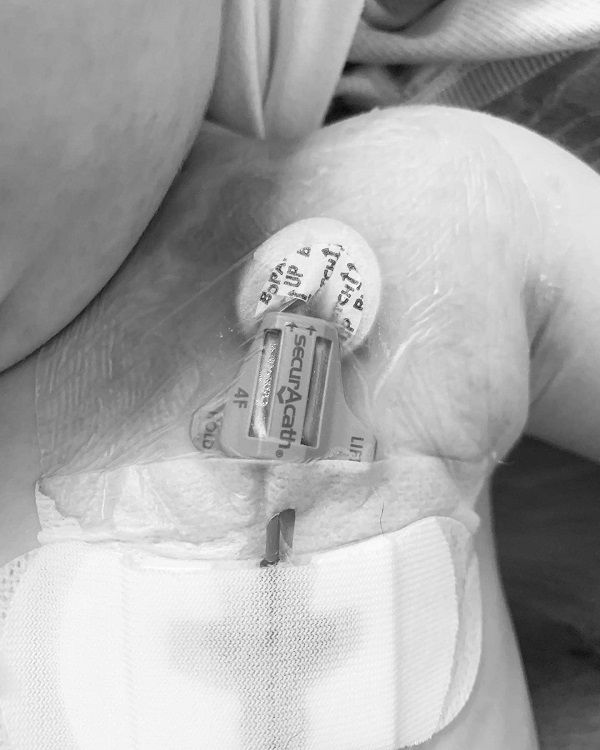
PICC, or a peripherally inserted central catheter.
That was my little friend for just under three months. It helped me so much, but at the same time, it put me through quite a lot.
So, what exactly is a PICC?
PICC (pronounced “pick”) stands for peripherally inserted central catheter. It is a long, thin, flexible tube designed for short-term to long-term infusion therapy. It is inserted through a vein and advanced into the superior vena cava (the large vein that carries blood to the heart). A PICC provides permanent venous access. It can be used to administer medication directly into a vein, draw blood, and more. The main advantage of a PICC is that it can remain in place throughout the entire course of treatment, without the need to repeatedly insert other types of cannulas.
In my case, it was inserted primarily because I needed to have my blood drawn so frequently. After receiving Zolgensma, my blood levels had to be monitored constantly so that any potential side effects or adverse reactions to the treatment could be detected and addressed by the doctors in time.
It was also the reason I had to undergo anaesthesia, when they took me away from Mum to the operating theatre. The insertion takes approximately 30–60 minutes, depending on the individual. Apparently, I was in the operating theatre for just under 45 minutes, but for Mum and Dad, it felt like an eternity.
Once the PICC had been inserted, they brought me back to Mum, transferred me into my little bed, and began waking me up. When I woke up, I cried a lot. I was covered in disinfectant, wrapped up in bandages, one of my little arms and one of my legs were “out of action,” and I had the PICC inserted in my chest.
It was not pleasant at all. It restricted my movement, especially when I wanted to lie on my tummy. The tube and its entry point kept pressing against me. But somehow, I learned to live with it.
But the unpleasant experiences didn’t end there.
A PICC like this requires regular care to prevent complications such as infections. Every week, Mum and I went to the hospital to have blood drawn through the PICC and to have the entire dressing changed (removing the adhesive dressings, cleaning the area with disinfectant, and applying new dressings), as well as having the catheter flushed with saline solution (which helps prevent it from becoming blocked).
As soon as Mum laid me down on the examination couch, I would start crying because I knew what was coming. It doesn’t actually hurt, but it is very uncomfortable. Mum has to hold my arms, legs, and head firmly so that I don’t pull the tube out and hurt myself. The nurses peel off the adhesive dressings, which pulls at my skin, then disinfect the area and cover it up again. At the same time, they draw blood from the catheter.
After the whole procedure, I am always so sweaty and exhausted that I fall asleep in my pram almost immediately and sleep for two hours.
But on the other hand, I am grateful that I have it. I can’t imagine having them prick my little body and draw blood every single week. They usually take around ten vials of blood from me, and nobody would want to go through that every week for three months.
And whenever I got bored, my favourite activity was peeling off the dressings and tugging at the tube.
Mum was beside herself and had to keep a constant eye on me. Even bath time was difficult for Mum. It always took two people to bathe me. The PICC must not get wet. And because I love water and enjoy splashing around, one person had to hold my hands while the other washed me. I cried SO much every single time because someone was restricting my movement again.
I even managed to peel the whole thing off completely several times.
Like one morning. Mum checked my PICC every morning. As usual, she came to get me out of my cot, only to find me lying there with all the dressings ripped off, the tube in my hand, and the PICC exposed.
Mum nearly fainted when she saw it exposed, but I just laughed about it.
So we had to rush back to the hospital to have the dressing changed. And this happened over and over again. Every time something needed to be done to the PICC, we had to go to Motol, on top of our regular weekly check-ups. So Mum, Dad, and I spent most days of the week at the hospital.
I’ve had it removed now.
Over the last few weeks, I’ve had some major complications. The insertion site is covered with a special adhesive dressing containing gel. And I started developing an allergic reaction to it. The wound became wet and weepy, and I developed a rash all over my body. I had blisters around the wound, and it hurt a lot and itched everywhere.
Mum immediately bundled me into the car (you can’t even imagine how quickly she got me in there!) and rushed me to the hospital, where they took care of me straight away.
In the end, it was decided that the PICC had to be removed, because the reaction was so severe that it had to come out. Fortunately, we were already nearing the end of my treatment, and they had been planning to remove it anyway.
The PICC stays in your little body until your blood test results are good and you no longer need to take corticosteroids to protect your liver. Luckily, my liver function tests were normal at every check-up, so I only had to take corticosteroids for two months.
Hopefully, things are finally starting to look brighter.
When you no longer need to take corticosteroids and the PICC has been removed, hospital check-ups become less frequent, too.
I am no longer restricted in my movements, which means Mum and I can finally get down to some serious work to turn our dream into reality.
E. 🧡