About SMA
THE GENETIC LOTTERY THAT MUM AND DAD “LOST”.
Spinal muscular atrophy, also known as spinal muscular atrophy (SMA).
Spinal muscular atrophy is considered a serious inherited neuromuscular disorder that affects part of the nervous system responsible for controlling the muscles needed for movement of the upper and lower limbs, the head, the respiratory muscles and swallowing. People affected by this condition gradually lose the ability to move independently.
The condition causes progressively worsening muscle weakness, particularly in the legs, followed by declining mobility in the arms and, eventually, the complete loss of movement throughout the body.
The course of the disease is different for every individual. Nevertheless, SMA occurs in several forms, each with a different rate of progression. It is specifically classified into four types.
1.
Type one (Werdnig-Hoffmann)
The most severe form of the condition. It appears very early after birth, by the sixth month at the latest. The children cannot sit on their own. Muscle weakness progresses quickly and breathing difficulties soon follow. Without treatment, life expectancy is two years.
2.
Type two (Werdnig-Hoffmann II) – this is the type I have
A moderate and the most common form, appearing by 18 months of age. People with this type can learn to sit on their own, and sometimes even stand and take a few steps. They cannot walk on their own and rely on a wheelchair. They also have marked muscle fatigue, shortening of the tendons and severe scoliosis. Breathing difficulties develop later as well.
3.
Type three (Kugelberg-Welander)
A milder form of SMA that starts to appear after 18 months. At first it weakens both legs. The weakness gradually spreads to the arms, and problems with swallowing, breathing and speech follow. People with this type live into adulthood and lose mobility between the ages of 20 and 40.
4.
Type four (Aran-Duchenne)
The condition appears in adulthood and progresses very slowly.
Now comes the mystery. HOW DID I END UP WITH SMA, TOO?
No one in our family had ever even considered this condition. During her pregnancy, Mum underwent all the examinations offered to her by her gynaecologist. Since all the results were normal, no one expected that there could be a problem or that I might be so seriously ill.
It was only after my diagnosis that my parents learned from the doctors how this condition actually works.
Spinal muscular atrophy is a genetic disorder. What does that mean? All children inherit genes from their parents. Each gene has two copies. There is a healthy version of a gene and a damaged, or mutated, version. According to statistical estimates, the chance of an individual carrying a mutated gene is 1 in 50. You inherit one copy from Dad and the other copy from Mum.
It therefore depends on whether the parents carry a mutated gene at all. Neither parent necessarily has to carry one. However, if they do, the key question is how the genes are ultimately “mixed” — in other words, which version of the gene you inherit from each parent: the healthy one or the mutated, damaged one.
The explanation below applies when both parents carry one mutated copy of the gene. People who have two healthy copies are not affected by this particular inheritance pattern. An illustration has been included below to make this easier to understand.
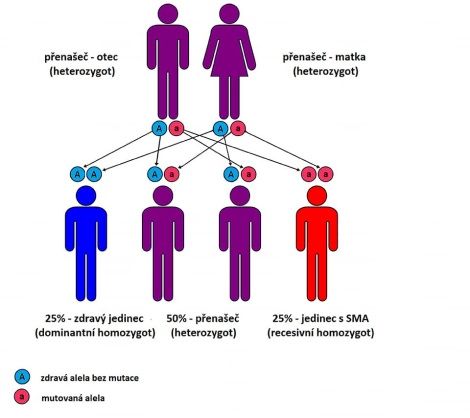
25%
A healthy form from both parents
is the probability that you inherit a healthy, unmutated form from Mum and the same healthy gene from Dad. You are a healthy individual.
25%
A healthy and a mutated form
is the probability that you inherit a healthy, unmutated form from Mum and a mutated, damaged gene from Dad. You become a healthy carrier. SMA does not appear, but there is a risk of passing it on to your children. The risk is the same for every child of the couple.
25%
A healthy and a mutated form
is the probability that you inherit a mutated, damaged gene from Mum and a healthy gene from Dad. You become a healthy carrier. SMA does not appear, but there is a risk of passing it on to your children. The risk is the same for every child of the couple.
25%
A mutated form from both parents
is the probability that you inherit a mutated gene from both parents. If that happens, you are born with SMA, as I was.
All of this means that, in my case, two carriers came together, neither of whom had any idea that they might carry a faulty gene. Mum and Dad therefore had a 25% chance of both passing on their mutated gene copies to me. Everything was explained to them only after my diagnosis.
The one thing that could have helped prevent this situation was AWARENESS AND INFORMATION FROM MEDICAL PROFESSIONALS.
And here is Mum’s message:
“You have the opportunity to undergo genetic testing for the most common genetic conditions (including SMA), so please take advantage of it. If Mum had known about this earlier, she and Dad could have had the tests before planning to have a baby.”
Although genetic tests are not covered by health insurance, as you can see, they are certainly worth considering.
Thanks to the tremendous efforts of several wonderful people and organisations working to raise awareness of SMA, and their pressure on the government, this important condition — spinal muscular atrophy — was added to newborn screening in January 2022. With their mother’s consent, babies can be screened in the maternity hospital shortly after birth. Babies are now tested for a total of 20 serious inherited conditions.
Mum has tried to explain everything as clearly and simply as possible. Hopefully, she has succeeded.
E.